


Information
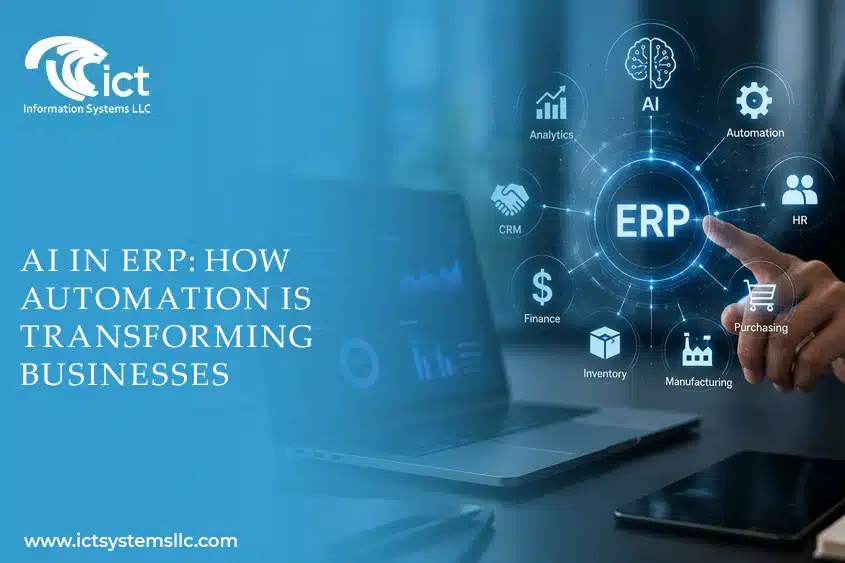
Artificial intelligence (AI) is no longer a futuristic concept. It has become a practical tool that helps businesses automate repetitive tasks, improve decision-making, and increase operational efficiency. When combined with Enterprise Resource Planning (ERP) systems, AI creates a smarter way to manage business operations. Companies are now using ERP software in Dubai to streamline workflows, reduce costs, and gain valuable business insights through intelligent automation.
As Dubai continues to strengthen its position as a global business hub, organizations across industries are adopting AI-powered ERP solutions to remain competitive. From finance and human resources to inventory management and customer service, AI is transforming how businesses operate every day.
What Is AI in ERP?
Artificial Intelligence in ERP refers to the integration of intelligent technologies such as machine learning, predictive analytics, natural language processing, and robotic process automation into an ERP system.
Traditional ERP systems collect and organize business data. AI-powered ERP goes a step further by analyzing that data, identifying patterns, predicting future outcomes, and recommending actions automatically.
Instead of simply storing information, AI helps businesses make faster and smarter decisions.
Why Businesses Are Investing in ERP Software in Dubai
Dubai has become one of the fastest-growing digital economies in the Middle East. Businesses are investing heavily in digital transformation to improve efficiency and customer experience.
Modern ERP software in Dubai helps organizations:
- Automate business processes
- Reduce operational costs
- Improve employee productivity
- Enhance customer satisfaction
- Make data-driven decisions
- Maintain compliance with UAE regulations
When AI capabilities are added, these benefits become even more powerful.
How AI Is Transforming ERP Systems
Intelligent Business Forecasting
Forecasting demand has always been one of the biggest challenges for businesses. AI analyzes historical sales data, seasonal trends, customer behavior, and market conditions to generate highly accurate forecasts.
Businesses can better plan:
- Inventory purchases
- Production schedules
- Staffing requirements
- Financial budgets
Accurate forecasting reduces waste while improving profitability.
Automated Financial Management
Finance teams spend countless hours processing invoices, reconciling accounts, and generating reports.
AI automates these repetitive activities by:
- Matching invoices automatically
- Detecting duplicate payments
- Identifying unusual transactions
- Predicting cash flow
- Generating financial reports
This allows finance professionals to focus on strategic planning instead of manual data entry.
Smarter Inventory Management
Inventory optimization is critical for retailers, manufacturers, and distributors.
AI-powered ERP software continuously monitors stock levels and predicts future demand.
It can automatically recommend:
- When to reorder products
- Which items are overstocked
- Which products may run out
- Optimal warehouse distribution
Businesses using ERP software in Dubai can reduce inventory carrying costs while avoiding stock shortages.
Predictive Maintenance
Manufacturing and industrial companies rely heavily on equipment performance.
AI can monitor machine data in real time and predict potential failures before they happen.
Benefits include:
- Reduced downtime
- Lower maintenance costs
- Longer equipment lifespan
- Improved production efficiency
Instead of repairing equipment after it breaks, businesses can schedule maintenance proactively.
Better Customer Relationship Management
Customer expectations continue to rise.
AI improves CRM functions inside ERP by analyzing customer interactions and purchasing behavior.
Businesses can:
- Personalize customer communication
- Predict customer needs
- Identify sales opportunities
- Improve customer retention
- Recommend relevant products
This creates a better customer experience while increasing revenue.
Faster Decision-Making Through Data Analytics
Businesses generate enormous amounts of data every day.
Without AI, analyzing this information can take hours or even days.
AI-powered ERP systems provide:
Real-Time Dashboards
Executives receive instant insights into:
- Sales performance
- Financial health
- Inventory levels
- Employee productivity
- Customer satisfaction
Predictive Analytics
Instead of only reviewing past performance, AI predicts future trends.
Business leaders can make proactive decisions rather than reacting to problems after they occur.
Human Resources Automation
Managing employees becomes much easier with AI-enabled ERP systems.
AI helps HR departments:
- Screen job applications
- Schedule interviews
- Predict employee turnover
- Automate payroll
- Track attendance
- Manage performance reviews
Employees also benefit from AI-powered self-service portals that answer HR-related questions instantly.
Supply Chain Optimization
Supply chains involve multiple vendors, transportation partners, warehouses, and customers.
AI helps optimize every stage by:
- Predicting supplier delays
- Optimizing delivery routes
- Reducing transportation costs
- Monitoring supplier performance
- Improving procurement decisions
Businesses gain greater visibility across their entire supply chain.
Improved Business Security
Cybersecurity is becoming increasingly important for businesses handling sensitive customer and financial data.
AI strengthens ERP security by:
- Detecting suspicious user behavior
- Monitoring unusual login attempts
- Identifying potential fraud
- Automatically responding to threats
This reduces security risks while protecting valuable business information.
Robotic Process Automation (RPA)
Many repetitive office tasks consume valuable employee time.
AI combined with Robotic Process Automation can automate processes such as:
- Data entry
- Invoice processing
- Purchase order creation
- Employee onboarding
- Expense approvals
- Report generation
Employees can then focus on higher-value strategic work.
Natural Language Processing (NLP)
Modern ERP software allows users to interact using natural language.
Instead of navigating complex menus, users can simply ask questions like:
- What were last month’s sales?
- Show pending purchase orders.
- Which products are running low?
AI instantly retrieves the requested information, improving productivity and ease of use.
Industries Benefiting from AI-Powered ERP Software in Dubai
Many industries are already seeing significant improvements through AI-enabled ERP solutions.
Manufacturing
Manufacturers use AI for production planning, predictive maintenance, inventory optimization, and quality control.
Retail
Retail businesses improve demand forecasting, inventory management, customer insights, and sales performance.
Healthcare
Hospitals and clinics automate patient records, billing, inventory tracking, and regulatory compliance.
Construction
Construction companies manage projects, budgets, procurement, workforce scheduling, and equipment maintenance more efficiently.
Logistics
Logistics providers optimize routes, warehouse operations, shipment tracking, and fleet management.
Professional Services
Consulting firms automate project management, billing, resource allocation, and financial reporting.
Key Benefits of AI-Powered ERP
Businesses adopting AI-integrated ERP solutions experience several long-term advantages.
Increased Productivity
Automation eliminates repetitive manual work, allowing employees to focus on innovation and customer service.
Better Accuracy
AI minimizes human errors in finance, inventory, procurement, and reporting.
Lower Operating Costs
Automated workflows reduce labor costs and improve resource utilization.
Faster Decision-Making
Real-time analytics help management respond quickly to changing business conditions.
Improved Customer Experience
AI enables personalized services, faster responses, and better customer engagement.
Greater Scalability
AI-powered ERP systems adapt as businesses grow without significantly increasing administrative workloads.
Challenges Businesses Should Consider
While AI delivers significant benefits, organizations should also plan for potential challenges.
Successful implementation requires:
- Clean and accurate business data
- Employee training
- Integration with existing systems
- Change management strategies
- Strong cybersecurity practices
Working with experienced ERP implementation professionals helps businesses overcome these challenges more efficiently.
The Future of ERP Software in Dubai
AI will continue to reshape ERP technology over the coming years.
Future ERP systems are expected to include:
- More advanced predictive analytics
- Autonomous business process automation
- AI-powered virtual assistants
- Enhanced cybersecurity intelligence
- Industry-specific AI capabilities
- Smarter workflow recommendations
As digital transformation accelerates across the UAE, businesses using intelligent ERP solutions will be better positioned to improve efficiency, reduce costs, and stay competitive.
Conclusion
Artificial intelligence is transforming ERP from a traditional business management tool into an intelligent decision-making platform. By automating routine processes, improving forecasting, enhancing customer experiences, and delivering real-time insights, AI enables organizations to operate more efficiently and make informed strategic decisions.
For companies seeking long-term growth and operational excellence, investing in ERP software in Dubai offers more than streamlined processes—it provides the foundation for innovation, scalability, and sustainable success in an increasingly digital business landscape.